















New Spin Record Set: 1 Million rpm

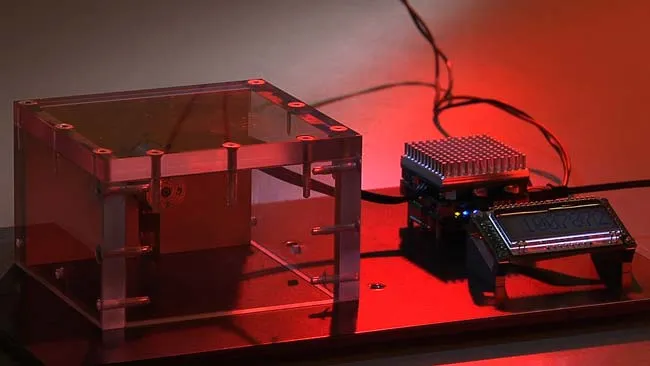
Industrial motors can spin at a head-spinning 250,000 revolutions per minute. But a new matchbook-sized motor runs circles around the competition.
Researchers from ETH Zurich's Department of Power Electronics created a drive system in cooperation with its industrial partners that exceeded 1,000,000 rpm in tests.
For a cosmic comparison, really old, collapsed stars can spin just over 60,000 rpm. Such stars are the epitome of the "skater who has pulled her arms in" analogy. Any faster and the stars would fly apart, theory holds. The typical kitchen blender rotates at about half that rate. High-performance car engines typically max out well under 10,000 rpm.
The rotor in the new device has a titanium shell to withstand flying apart like a star. Ultra-thin copper wire is used for the windings, which are inserted in a cylinder "made of special iron previously unused for machines," the researchers said in a statement. Top-secret stuff, apparently.
A Swiss company, Celeroton, has been founded to bring products to market based on the work.
The new motor could be applied for faster drills and more efficient and compact compressors for cars and airplanes. The trend towards increasingly smaller cell phones and other teensy electronic devices means ever smaller holes must be drilled to make them, and that requires higher rotational speeds, the researchers said.
"Our findings will rapidly be converted into concrete applications and products," said Johann Kolar, one of the researchers involved in the feat.
Get the world’s most fascinating discoveries delivered straight to your inbox.
- Bionic Humans: Top 10 Technologies
- Top 5 Most Outrageous James Bond Gadgets
- Great Inventions: Quiz Yourself
