 Live Science Plus





Archaeologists have discovered the remains of a 2,000-year-old bronze chariot at the Burrough Hill Iron Age Hillfortthat, a fortified hilltop. The remains include bronze chariot fittings, decorated linch pins and other artifacts. Here's a look at some of the remains found in the treasure trove, with photos courtesy of the University of Leicester. [Read full story on Iron Age chariot discovery]
Linch pins
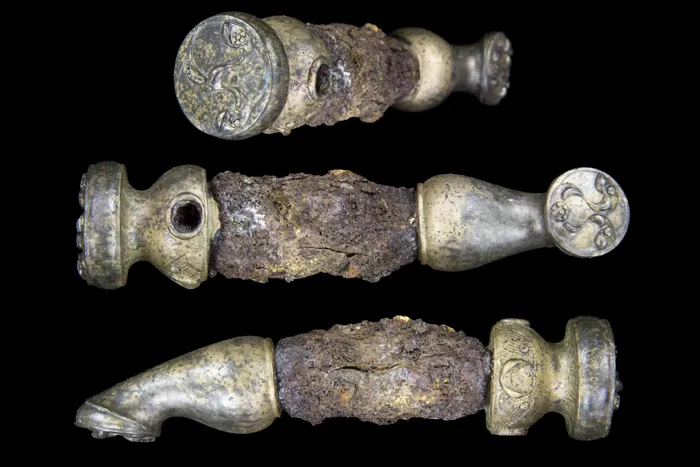
Four archaeology students who participated in a field project at Burrough Hill first discovered a bronze piece of chariot near an Iron Age house in the hillfort. More bronze remains were found nearby. Here, a chariot linch pin shown from three angles, revealing the intricate decoration at the ends of the piece.
Article continues belowDecorated endcaps

The chariot linch pin with an intricate metalworked design on each end found as part of an Iron Age burnt offering at Burrough Hill in Leicestershire, England. Here, decoration at the lower end of the linch pin can be seen.
Ornate pin

Here, a linch pin, showing the overall "J" shape and decoration toward the top that once belonged to the Iron Age chariot.
Isle of Man decoration

The bronze-fitted chariot once belonged to a warrior or noble, University of Leicester archaeologists said. One linch pin they found is decorated with a "triskele," or three wavy lines that radiate from a single point, similar to the modern flag for the Isle of Man. Here, an oblique view of the triskele decoration on the upper end of the linch pin.
Lots of fittings

The hoard of decorated bronze chariot fittings were burned as part of some sort of ritual during the second or third century B.C. This miniature terret ring (upper left), larger terret ring (upper right), strap junction (lower left) and harness fitting (lower right) are examples of bronze metalworking in the Iron Age.
Strap junction

A close look at a strap junction from the Iron Age chariot hoard. The remains were found in a chaff layer that may have been fuel for a burning ritual, the archaeologists said. After being set on fire, the chariot pieces had been placed in a box and covered with cinder and slag, something that may have been a ritual to mark the closing of the fort home, or possibly to honor the change of seasons, the archaeologists noted.
The ring

Detail of the miniature terret ring found with the remains of the Iron Age chariot.
Lipped ring

Details of one of the large terret rings showing the "lipped" decoration.
Horse grooming

Alongside the bronze chariot fittings were a set of iron tools. Archaeologists aren't sure what these tools were for, but this one looks like a curry comb used for horse grooming.
Follow us @livescience, Facebook & Google+.

