















What Are Elementary Particles?

Elementary particles are the smallest known building blocks of the universe. They are thought to have no internal structure, meaning that researchers think about them as zero-dimensional points that take up no space. Electrons are probably the most familiar elementary particles, but the Standard Model of physics, which describes the interactions of particles and almost all forces, recognizes 10 total elementary particles.
Electrons and related particles
Electrons are the negatively charged components of atoms. While they are thought to be zero-dimensional point particles, electrons are surrounded by a cloud of other virtual particles constantly winking in and out of existence, that essentially act as part of the electron itself. Some theories have predicted that the electron has a slightly positive pole and a slightly negative pole, meaning that this cloud of virtual particles should therefore be a bit asymmetrical.
If this were the case, electrons might behave differently than their antimatter doubles, positrons, potentially explaining many mysteries about matter and antimatter. But physicists have repeatedly measured the shape of an electron and found it to be perfectly round to the best of their knowledge, leaving them without answers for antimatter's conundrums.
The electron has two heavier cousins, called the muon and the tau. Muons can be created when high-energy cosmic rays from outer space hit the top of Earth's atmosphere, generating a shower of exotic particles. Taus are even rarer and harder to produce, as they are more than 3,400 times heavier than electrons. Neutrinos, electrons, muons and taus make up a category of fundamental particles called leptons.
Quarks and their quirkiness
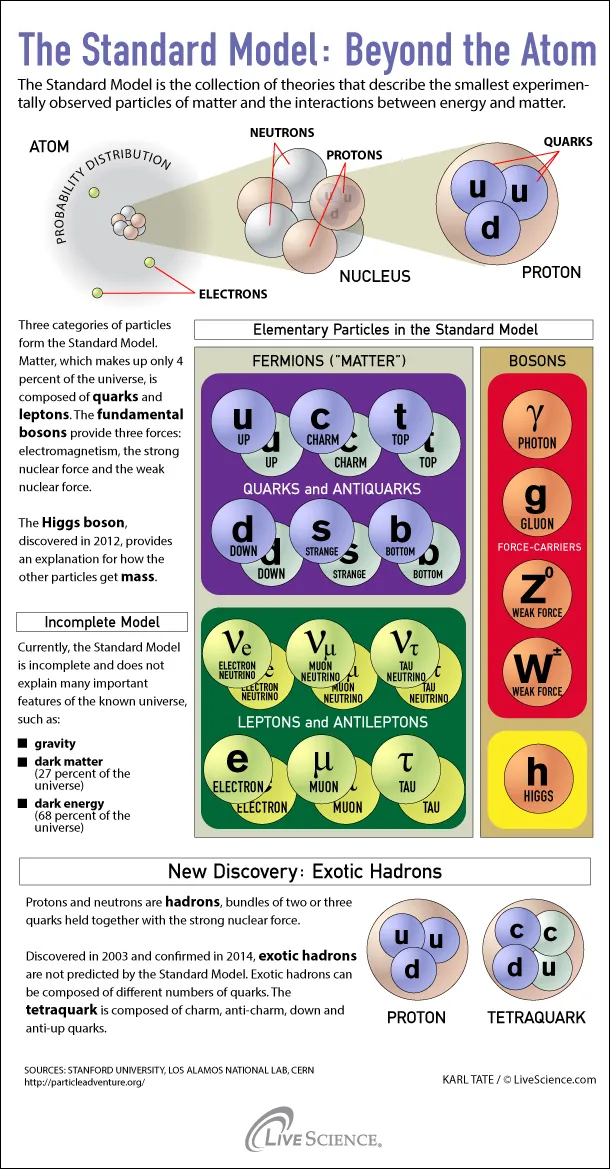
Quarks, which make up protons and neutrons, are another type of fundamental particle. Together with the leptons, quarks make up the stuff we think of as matter.
Once upon a time, scientists believed that atoms were the smallest possible objects; the word comes from the Greek "atomos," meaning "indivisible." Around the turn of the 20th century, atomic nuclei were shown to consist of protons and neutrons. Then, throughout the 1950s and '60s, particle accelerators kept revealing a bevy of exotic subatomic particles, such as pions and kaons.
In 1964, physicists Murray Gell-Mann and George Zweig independently proposed a model that could explain the inner workings of protons, neutrons and the rest of the particle zoo, according to a historical report from SLAC National Accelerator Laboratory in California. Residing inside protons and neutrons are tiny particles called quarks, which come in six possible types or flavors: up, down, strange, charm, bottom and top.
Get the world’s most fascinating discoveries delivered straight to your inbox.
Protons are made from two up quarks and a down quark, while neutrons are composed of two downs and an up. The up and down quarks are the lightest varieties. Because more-massive particles tend to decay into less massive ones, the up and down quarks are also the most common in the universe; therefore, protons and neutrons make up most of the matter we know.
By 1977, physicists had isolated five of the six quarks in the lab — up, down, strange, charm and bottom — but it wasn't until 1995 that researchers at Fermilab National Accelerator Laboratory in Illinois found the final quark, the top quark. Searching for it had been as intense as the later hunt for the Higgs boson. The top quark was so hard to produce because it's about 100 trillion times heavier than up quarks, meaning it required a lot more energy to make in particle accelerators.

Nature's fundamental particles
Then there are the four fundamental forces of nature: electromagnetism, gravity, and the strong and weak nuclear forces. Each of these has an associated fundamental particle.
Photons are the most well-known; they carry the electromagnetic force. Gluons carry the strong nuclear force and reside with quarks inside of protons and neutrons. The weak force, which mediates certain nuclear reactions, is carried by two fundamental particles, the W and Z bosons. Neutrinos, which only feel the weak force and gravity, interact with these bosons, and so physicists were able to first provide evidence for their existence using neutrinos, according to CERN.
Gravity is an outsider here. It isn't incorporated into the Standard Model, though physicists suspect that it could have an associated fundamental particle, which would be called the graviton. If gravitons exist, it might be possible to create them at the Large Hadron Collider (LHC) in Geneva, Switzerland, but they would rapidly disappear into extra dimensions, leaving behind an empty zone where they would have been, according to CERN. So far, the LHC has seen no evidence of gravitons or extra dimensions.

The elusive Higgs boson
Finally, there is the Higgs boson, the king of the elementary particles, which is responsible for giving all other particles their mass. Hunting for the Higgs was a major endeavor for scientists striving to complete their catalog of the Standard Model. When the Higgs was finally spotted, in 2012, physicists rejoiced, but the results have also left them in a difficult spot.
The Higgs looks pretty much exactly like it was predicted to look, but scientists were hoping for more. The Standard Model is known to be incomplete; for instance, it lacks a description of gravity, and researchers thought finding the Higgs would help point to other theories that could supersede the Standard Model. But so far, they have come up empty in that search.
Additional resources:
- Learn more about the Standard Model, from CERN.
- Read more about particle history and elementary particles, from Particle Central.
- Watch: Explainer video on elementary particles, from the Jefferson Lab.

Adam Mann is a freelance journalist with over a decade of experience, specializing in astronomy and physics stories. He has a bachelor's degree in astrophysics from UC Berkeley. His work has appeared in the New Yorker, New York Times, National Geographic, Wall Street Journal, Wired, Nature, Science, and many other places. He lives in Oakland, California, where he enjoys riding his bike.