













Giant Clams Fed Early Humans

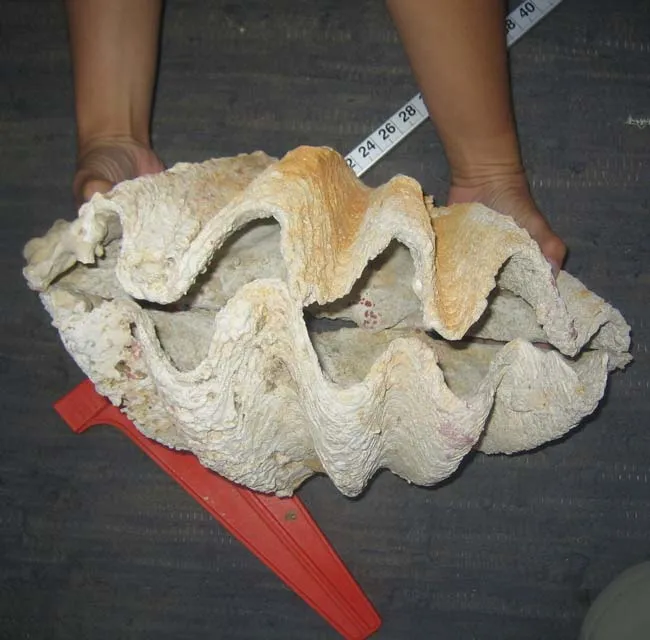
Giant clams two feet long might have helped feed prehistoric humans as they first migrated out of Africa, new research reveals.
The species, Tridacna costata, once accounted for more than 80 percent of giant clams in the Red Sea, researcher now say. Today, these mollusks, the first new living species of giant clam found in two decades, represent less than 1 percent of giant clams living there.
This novel clam, whose shell has a distinctive scalloped edge, was discovered while scientists were attempting to develop a breeding program for another giant clam species, Tridacna maxima, which is prized in the aquarium trade. The new species appears to live only in the shallowest waters, which makes it particularly vulnerable to overfishing.
"These are all strong indications that T. costata may be the earliest example of marine overexploitation," said researcher Claudio Richter, a marine ecologist at the Alfred-Wegener-Institute for Polar and Marine Research in Bremerhaven, Germany.
Fossil evidence that the researchers uncovered suggests the stocks of these giant clams began crashing some 125,000 years ago, during the last interval between glacial periods. During that time, scientists think modern humans first emerged out of Africa, Richter said.
These mollusks could have played a key role in feeding people during that crucial era, serving as a prime target due to their large size, the scientists added. Indeed, competition for these clams and other valuable sea resources "may have been an important driver for human expansion," Richter told LiveScience.
Since this new species bore some features in common with two other living species of Red Sea clams, at first the researchers thought the new mollusk might have been a hybrid, but genetic analysis showed otherwise. These results were further corroborated by marked differences in behavior — while the other two clams spawn over a long period in summer, the new species reproduces during a brief spurt in spring.
Get the world’s most fascinating discoveries delivered straight to your inbox.
No one had expected to discover a new giant clam species, "particularly in the Red Sea, one of the best investigated coral reef provinces," Richter said. The fact that it was overlooked for so long "is a testimony as to how little we really know about marine biodiversity."
Underwater surveys carried out in the Gulf of Aqaba (north of the Red Sea, between the Sinai Peninsula and Arabian mainland) and northern Red Sea revealed this long-overlooked clam must be considered critically endangered. Only six out of 1,000 live specimens the scientists observed belonged to the new species. This mollusk could be the earliest victim of human degradation of coral reefs in this region, the researchers added.
The scientists detailed their findings online on Aug. 28 in the journal Current Biology.
- Image Gallery – Invasive Species
- Is the Red Sea Really Red?
