















How Dolphins Spin, and Why
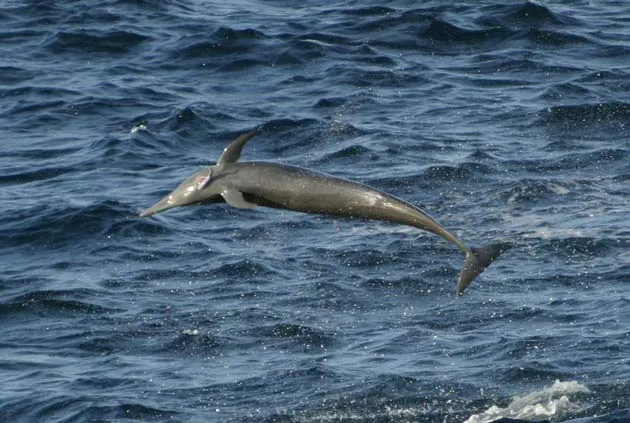
Spinner dolphins work hard to earn their name. In one astounding leap into the air, they can spin around up to seven times. With underwater movie footage and a mathematical model, scientists can now explain just how dolphins manage the acrobatic feat.
Before takeoff, the animal begins its spin underwater.
Using its flippers like wings, it starts a gentle barrel roll. The movement is slow because the dolphin's fin and flippers drag against the water, which adds a lot of resistance.
Try this at home
| Mystery Monday |
| Each Monday, LiveScience will step back from the news and explore an amazing aspect of the natural world. This is the inaugural installment of Mystery Monday. As always, we'd love to hear what you think. Contact LiveScience. |
It's like having your hand in the bathtub, says West Chester University physicist Anthony Nicastro. "You can feel resistance, due to all that water you're pushing around," Nicastro explained. "The dolphin has flippers, a dorsal fin, and other surfaces dragging water. Underwater, they generate 1 or 2 spins per second."
Once a dolphin breaks the surface, everything changes.
As it enters the air, the dolphin sheds all of the resistant forces that slowed it down in the water. And that's when things really get dizzy.
Get the world’s most fascinating discoveries delivered straight to your inbox.
Airborne, the spinner dolphin can make up to seven revolutions in as little as a second.
Previous studies suggested that a dolphin generated the spins by the way it twisted its body, once it broke the surface. "You're not going to spin much at all from a flat jump. It just doesn't make sense in a real world model," says biologist Frank Fish, also from West Chester University.
By using calculus, the mathematical model that Nicastro came up with correctly describes how the spin works. The results were published in the January 2006 issue of the Journal of Experimental Biology.
But why?
Nobody knows for sure why spinner dolphins spin. There could be all kinds of reasons: to display dominance, to communicate their location, to hunt, or just for fun.
It could also be an easy way to shake off fish taking a free ride.
Remoras, fish with dorsal fins that acts like suction cups, stick to sharks and whales. The suckers add extra drag to a dolphin's streamlining, says Fish the biologist. Curious to learn what it felt like to have a remora suck him, Fish stuck one on his back. "They went into my skin—it hurt!" he says.
Dolphins have sensitive skin with lots of nerve endings, so remoras may be an irritant to the animals, Fish figures.
When a dolphin jumps into the air and spins, remoras flail out. And when the dolphin lands on the surface, with a huge splash, it will knock off the pesky pisces.
"If the dolphin weren't spinning, the remoras would stay on. The spinning action is what knocks off the remora," Nicastro said.
- Whale-Dolphin Hybrid Has Baby 'Wholphin'
- Armed Dolphins Said Set Loose in Gulf by Katrina
- Tourists Seek Glimpse of Pink Dolphins
- Did Sub Sonar Kill Dolphins?