Where's Your Climate Going?
Get the world’s most fascinating discoveries delivered straight to your inbox.
You are now subscribed
Your newsletter sign-up was successful
Want to add more newsletters?
Delivered Daily
Daily Newsletter
Sign up for the latest discoveries, groundbreaking research and fascinating breakthroughs that impact you and the wider world direct to your inbox.
Once a week
Life's Little Mysteries
Feed your curiosity with an exclusive mystery every week, solved with science and delivered direct to your inbox before it's seen anywhere else.
Once a week
How It Works
Sign up to our free science & technology newsletter for your weekly fix of fascinating articles, quick quizzes, amazing images, and more
Delivered daily
Space.com Newsletter
Breaking space news, the latest updates on rocket launches, skywatching events and more!
Once a month
Watch This Space
Sign up to our monthly entertainment newsletter to keep up with all our coverage of the latest sci-fi and space movies, tv shows, games and books.
Once a week
Night Sky This Week
Discover this week's must-see night sky events, moon phases, and stunning astrophotos. Sign up for our skywatching newsletter and explore the universe with us!
Join the club
Get full access to premium articles, exclusive features and a growing list of member rewards.
We hear that the air is getting warming, glaciers are melting, sea levels are rising, and carbon dioxide levels are climbing, all at alarming rates, but from our point of view on Earth, shifts in climate seem to happen at a snail's pace.
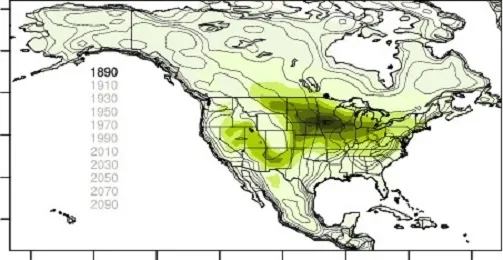
To help us visualize what some of these changes will mean in more tangible terms, researchers at Lawrence Berkeley National Laboratory in California have made interactive maps to show how current climates on the planet will march from one area to another as global temperatures rise. Among one of the team's more troubling finds was that the planet's boreal forests, which suck up and store a huge chunk of the world's terrestrial carbon, will shift, not expand toward the poles.

By the end of the century, a forest near Alberta, Canada, for example, will inherit a climate that's currently 100 miles to the south, the researchers say. This also means the forest will need to move 100 miles north to keep up with its climate. "Forests can't adapt this quickly, however, meaning that in the short-term they'll be stressed. And in the long-term they'll be forced to move north and give up their southern regions to grassland," reads a press release from the lab.
You can explore how the climates are expected to creep around the world here: http://esd.lbl.gov/about/staff/charleskoven/climate_vectors.html
Follow Megan Gannon on Twitter and Google+. Follow us @livescience, Facebook & Google+. Original article on LiveScience.com.
Get the world’s most fascinating discoveries delivered straight to your inbox.