Several Large Earthquakes in Recent Days Unrelated, Scientist Says
Get the world’s most fascinating discoveries delivered straight to your inbox.
You are now subscribed
Your newsletter sign-up was successful
Want to add more newsletters?
Delivered Daily
Daily Newsletter
Sign up for the latest discoveries, groundbreaking research and fascinating breakthroughs that impact you and the wider world direct to your inbox.
Once a week
Life's Little Mysteries
Feed your curiosity with an exclusive mystery every week, solved with science and delivered direct to your inbox before it's seen anywhere else.
Once a week
How It Works
Sign up to our free science & technology newsletter for your weekly fix of fascinating articles, quick quizzes, amazing images, and more
Delivered daily
Space.com Newsletter
Breaking space news, the latest updates on rocket launches, skywatching events and more!
Once a month
Watch This Space
Sign up to our monthly entertainment newsletter to keep up with all our coverage of the latest sci-fi and space movies, tv shows, games and books.
Once a week
Night Sky This Week
Discover this week's must-see night sky events, moon phases, and stunning astrophotos. Sign up for our skywatching newsletter and explore the universe with us!
Join the club
Get full access to premium articles, exclusive features and a growing list of member rewards.
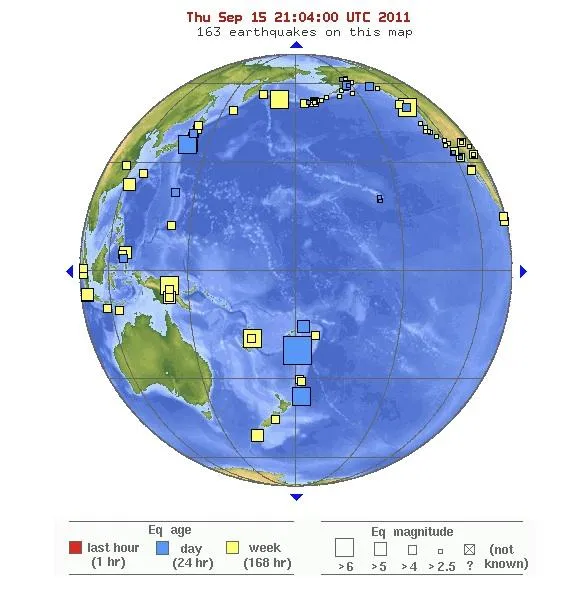
A flurry of recent earthquakes has rumbled in the Pacific, but they are normal for the region and not related to each other, according to the U.S. Geological Survey (USGS).
A magnitude 7.3 earthquake struck deep underground near Fiji today (Sept. 15). A magnitude 6.2 quake also struck off the coast of the Japanese island of Honshu, where earlier this year a massive magnitude 9.0 quake devastated the country . New Zealand saw a 6.0 quake off its North Island today. Yesterday a 6.1 magnitude quake struck Alaska's Aleutian Islands, and last week a magnitude 6.4 quake struck near Vancouver Island, with shaking felt as far away as Seattle, Wash.

The quakes were all in the same seismic area, but other than that, they are unrelated, said geophysicist John Bellini of the USGS. The quakes all struck in the seismically and volcanically active Pacific Ring of Fire , but they were not triggered by each other.
"When things like that happen [one quake triggering another], it's usually immediately after," Bellini told OurAmazingPlanet.
For example, when a large earthquake hits in the Gulf of California, it's common for quakes to immediately follow in Yellowstone, Bellini said.
A magnitude 7.3 is typical for the region near Fiji, and the quake was much too deep 389 miles (626 kilometers) below the Earth's surface to trigger a tsunami, Bellini said.
- 7 Most Dangerous Places on Earth
- Image Gallery: This Millennium's Destructive Earthquakes
- The 10 Biggest Earthquakes in History
7 Most Dangerous Places on Earth
Get the world’s most fascinating discoveries delivered straight to your inbox.
You can follow OurAmazingPlanet staff writer Brett Israel on Twitter: @btisrael. Follow OurAmazingPlanet for the latest in Earth science and exploration news on Twitter @OAPlanet and on Facebook.
