It's quick and easy to access Live Science Plus, simply enter your email below. We'll send you a confirmation and sign you up for our daily newsletter, keeping you up to date with the latest science news.
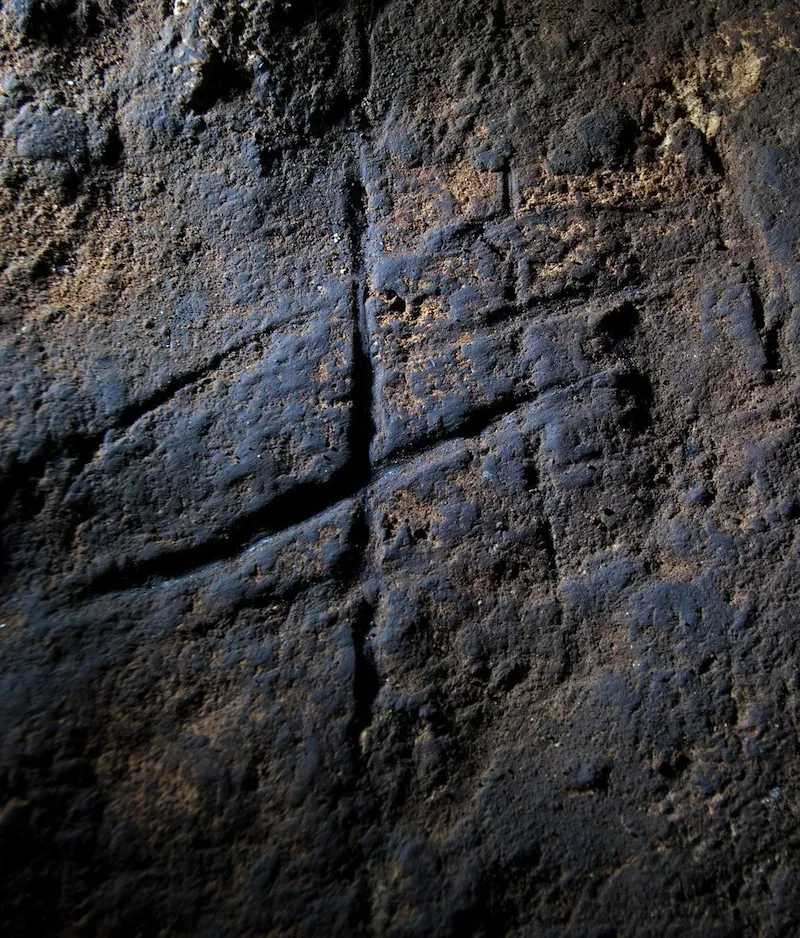
This abstract cave carving is possibly the first known example of Neanderthal rock art. The etching covers an area of about 47 square inches (300 square centimeters).
Around 39,000 years ago, a Neanderthal huddled in the back of a seaside cave at Gibraltar, safe from the hyenas, lions and leopards that might have prowled outside. Under the flickering light of a campfire, he or she used a stone tool to carefully etch what looks like a grid or a hashtag onto a natural platform of bedrock.
Archaeologists discovered this enigmatic carving during an excavation of Gorham's Cave two years ago. They had found Neanderthal cut marks on bones and tools before, but they had never seen anything like this. The researchers used Neanderthal tools to test how this geometric design was made — and to rule out the possibility the "artwork" wasn't just the byproduct of butchery. They found that recreating the grid was painstaking work.
"This was intentional — this was not somebody doodling or scratching on the surface," said study researcher Clive Finlayson, director of the Gibraltar Museum. But the discovery poses much more elusive questions: Did this engraving hold any symbolic meaning? Can it be considered art? [Video: First Neanderthal Rock Art Revealed]
Close cousins
Neanderthals roamed Eurasia from around 200,000 to 30,000 years ago, when they mysteriously went extinct. They were the closest known relatives of modern humans, and recent research has suggested that Neanderthals might have behaved more like Homo sapiens than previously thought: They buried their dead, they used pigments and feathers to decorate their bodies, and they may have even organized their caves.
Despite a growing body of evidence suggesting Neanderthals may have been cognitively similar to modern humans, a lack of art seemed to be the "the last bastion" for the argument that Neanderthals were much different from us, Finlayson said.
"Art is something else — it's an indication of abstract thinking," Finlayson told Live Science.
Sign up for the Live Science daily newsletter now
Get the world’s most fascinating discoveries delivered straight to your inbox.
Gorham's Cave may be the last known site of Neanderthal occupation before these hominids went extinct. In 2006, a carbon-dating study of charcoal from hearths inside the cave suggested that Neanderthals might have survived there until 28,000 years ago.
(Image credit: Clive Finlayson)
In Gorham's Cave, Finlayson and colleagues were surprised to find a series of deeply incised parallel and crisscrossing lines when they wiped away the dirt covering a bedrock surface. The rock had been sealed under a layer of soil that was littered with Mousterian stone tools (a style long linked to Neanderthals). Radiocarbon dating indicated that this soil layer was between 38,500 and 30,500 years old, suggesting the rock art buried underneath was created sometime before then. [See Photos of Europe's Oldest Rock Art]
Gibraltar is one of the most famous sites of Neanderthal occupation. At Gorham's Cave and its surrounding caverns, archaeologists have found evidence that Neanderthals butchered seals, roasted pigeons and plucked feathers off birds of prey. In other parts of Europe, Neanderthals lived alongside humans — and may have even interbred with them. But 40,000 years ago, the southern Iberian Peninsula was a Neanderthal stronghold. Modern humans had not spread into the area yet, Finlayson said.
To test whether they were actually looking at an intentional design, the researchers decided to try to recreate the grid on smooth rock surfaces in the cave using actual stone tools left behind in a spoil heap by archaeologists who had excavated the site in the 1950s. More than 50 stone-tool incisions were needed to mimic the deepest line of the grid, and between 188 and 317 total strokes were probably needed to create the entire pattern, the researchers found. Their findings were described yesterday (Sept. 1) in the journal Proceedings of the National Academy of Sciences.
Finlayson and his colleagues also tried to cut pork skin with the stone tools, to test whether the lines were merely the incidental marks left behind after the Neanderthals had butchered meat. But they couldn't replicate the engraving.
"You cannot control the groove if you're cutting through meat, no matter how hard you try," Finlayson said. "The lines go all over the place."
A simple grid is no Venus figurine
The Neanderthals' brand of abstract expressionism might not have impressed Homo sapiens art critics of the day.
"It's very basic. It's very simple," said Jean-Jacques Hublin, director of the Department of Human Evolution at the Max Planck Institute for Evolutionary Anthropology in Germany. "It's not a Venus. It's not a bison. It's not a horse."
By the late Stone Age, modern humans who settled in Europe were already dabbling in representational art. At least a dozen different species of animals — including horses, mammoths and cave lions — are depicted in the Chauvet Cave paintings, which are up to 32,000 years old. The anatomically explicit Venus figurine discovered at Hohle Fels Cave in southwestern Germany dates back to 35,000 years ago. Other busty female statuettes — the Venus of Galgenberg and the Venus of Dolní Věstonice — date back to about 30,000 years ago.
"There is a huge difference between making three lines that any 3-year-old kid would be able to make and sculpting a Venus," Hublin, who was not involved in the study, told Live Science.
Hublin said this discovery doesn't close the question of Neanderthals' cognitive skills. Proof that Neanderthals were capable of making a deliberate rock carving isn't evidence that they were regularly making art, he said.
"My own feeling is that if Neanderthals regularly used symbols, and given their longtime occupation throughout large parts of the Old World, we probably would have found clearer evidence by now," said Harold Dibble, an archaeologist at the University of Pennsylvania, who also was not involved in the study.
Dibble said he was convinced these markings were deliberate, but scientists need "more than a few scratches — deliberate or not — to identify symbolic behavior on the part of Neanderthals."
"Symbols, by definition, have meanings that are shared by a group of people, and because of that, they are often repeated," Dibble wrote in an email. "By itself, this is a unique example and without any intrinsic meaning … the question is not 'Could it be symbolic?' but rather 'Was it symbolic?' And to demonstrate that, it would be very important to have repeated examples."
Megan has been writing for Live Science and Space.com since 2012. Her interests range from archaeology to space exploration, and she has a bachelor's degree in English and art history from New York University. Megan spent two years as a reporter on the national desk at NewsCore. She has watched dinosaur auctions, witnessed rocket launches, licked ancient pottery sherds in Cyprus and flown in zero gravity. Follow her on Twitter and Google+.

 Live Science Plus