













SAN FRANCISCO — The ancient Mayan civilization collapsed due to a century-long drought, new research suggests.
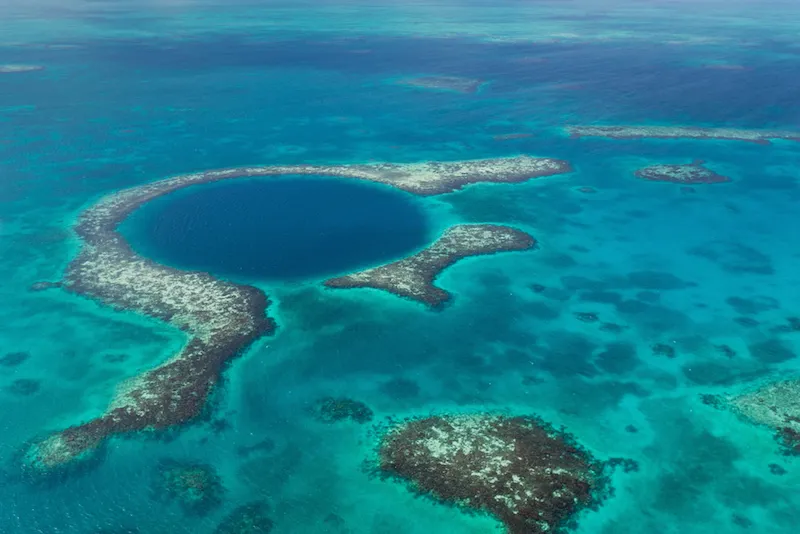
Minerals taken from Belize's famous underwater cave, known as the Blue Hole, as well as lagoons nearby, show that an extreme drought occurred between A.D. 800 and A.D. 900, right when the Mayan civilization disintegrated. After the rains returned, the Mayans moved north — but they disappeared again a few centuries later, and that disappearance occurred at the same time as another dry spell, the sediments reveal. [In Photos: Stunning Sinkholes]
Although the findings aren't the first to tie a drought to the Mayan culture's demise, the new results strengthen the case that dry periods were indeed the culprit. That's because the data come from several spots in a region central to the Mayan heartland, said study co-author André Droxler, an Earth scientist at Rice University.
Rise and decline
From A.D. 300 to A.D. 700, the Mayan civilization flourished in the Yucatan peninsula. These ancient Mesoamericans built stunning pyramids, mastered astronomy, and developed both a hieroglyphic writing system and a calendar system, which is famous for allegedly predicting that the world would end in 2012.
But in the centuries after A.D. 700, the civilization's building activities slowed and the culture descended into warfare and anarchy. Historians have speculatively linked that decline with everything from the ancient society's fear of malevolent spirits to deforestation completed to make way for cropland to the loss of favored foods, such as the Tikal deer.
The evidence for a drought has been growing in recent years: Since at least 1995, scientists have been looking more closely at the effects of drought. A 2012 study in the journal Science analyzed a 2,000-year-old stalagmite from a cave in southern Belize and found that sharp decreases in rainfall coincided with periods of decline in the culture. But that data came from just one cave, which meant it was difficult to make predictions for the area as a whole, Droxler said.
Get the world’s most fascinating discoveries delivered straight to your inbox.
The main driver of this drought is thought to have been a shift in the intertropical convergence zone (ITCZ), a weather system that generally dumps water on tropical regions of the world while drying out the subtropics. During summers, the ITCZ pelts the Yucatan peninsula with rain, but the system travels farther south in the winter. Many scientists have suggested that during the Mayan decline, this monsoon system may have missed the Yucatan peninsula altogether.
Deep history
To look for signs of drought, the team drilled cores from the sediments in the Blue Hole of Lighthouse lagoon, as well one in the Rhomboid reef. The lagoons surrounded on all sides by thick walls of coral reef. During storms or wetter periods, excess water runs off from rivers and streams, overtops the retaining walls, and is deposited in a thin layer at the top of the lagoon. From there, all the sediments from these streams settle to the bottom of the lagoon, piling on top of each other and leaving a chronological record of the historical climate.
"It's like a big bucket. It's a sediment trap," Droxler told Live Science.
Droxler and his colleagues analyzed the chemical composition of the cores, in particular the ratio of titanium to aluminum. When the rains fall, it eats away at the volcanic rocks of the region, which contain titanium. The free titanium then sweeps into streams that reach the ocean. So relatively low ratios of titanium to aluminum correspond to periods with less rainfall, Droxler said.
The team found that during the period between A.D. 800 and A.D. 1000, when the Maya civilization collapsed, there were just one or two tropical cyclones every two decades, as opposed to the usual five or six. After that, the Maya moved north, building at sites such as Chichen Itza, in what is now Mexico.
But the new results also found that between A.D. 1000 and A.D. 1100, during the height of the Little Ice Age, another major drought struck. This period coincides with the fall of Chichen Itza.
The findings strengthen the case that drought helped usher in the long decline of the Mayan culture.
"When you have major droughts, you start to get famines and unrest," Droxler said.
Follow Tia Ghose on Twitter and Google+. Follow Live Science @livescience, Facebook & Google+. Originally published on Live Science.

Tia is the editor-in-chief (premium) and was formerly managing editor and senior writer for Live Science. Her work has appeared in Scientific American, Wired.com, Science News and other outlets. She holds a master's degree in bioengineering from the University of Washington, a graduate certificate in science writing from UC Santa Cruz and a bachelor's degree in mechanical engineering from the University of Texas at Austin. Tia was part of a team at the Milwaukee Journal Sentinel that published the Empty Cradles series on preterm births, which won multiple awards, including the 2012 Casey Medal for Meritorious Journalism.