













Why Woodpeckers Don't Get Headaches
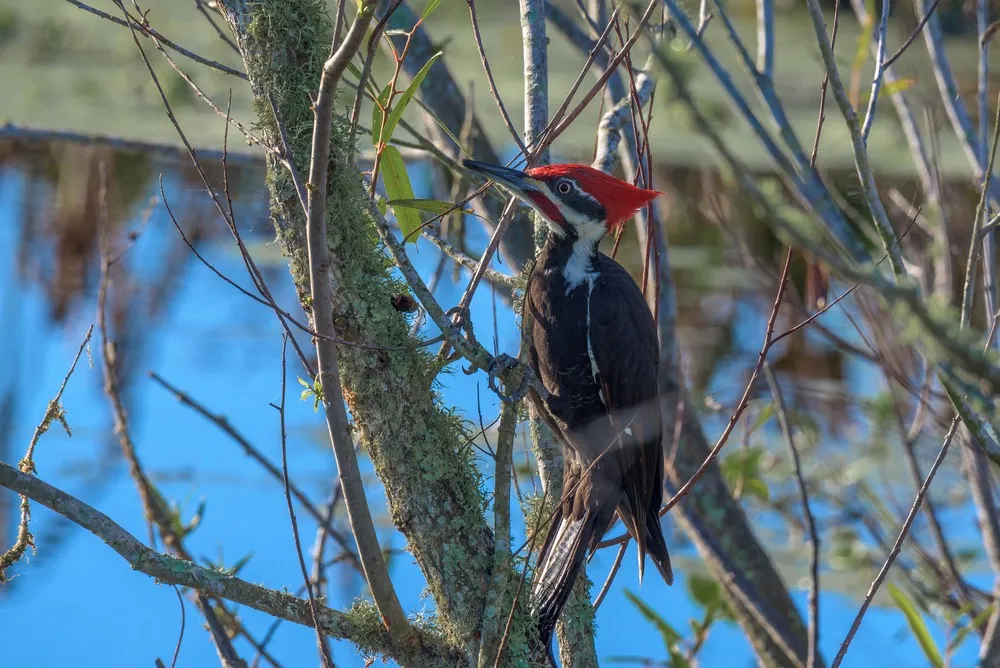
Pileated woodpeckers, the largest woodpeckers in North America, hammer their heads into trees with a force of 15 mph, 20 times a second. So how do their heads not turn to mush?
Thick muscles, sponge-like bones, and a third eyelid keep bird brains intact.
"If you get hit hard in the head, you can break blood vessels behind the eye or traumatize nerves behind eye," said University of California Davis ophthalmologist Ivan Schwab. "Seeing patients in car accidents and knowing what woodpeckers do made me wonder why these injuries don't happen in woodpeckers."
Last fall, Schwab was honored with an Ig Nobel award, the irreverent version of the Nobel Prize, for his research on how woodpeckers avoid headaches, published in the British Journal of Ophthalmology.
Headache cure
Along with their straight-as-an-arrow strikes at the tree, which safeguards against head trauma, birds' bodies are designed to absorb the impact.
One millisecond before a strike comes across the bill, dense muscles in the neck contract, and the bird closes its thick inner eyelid. Some of the force radiates down the neck muscles and protects the skull from a full blow. A compressible bone in the skull offers cushion, too.
Get the world’s most fascinating discoveries delivered straight to your inbox.
Meanwhile, the bird's closed eyelid shields the eye from any pieces of wood bouncing off the tree and holds the eyeball in place.
"The eyelid acts like a seat belt and keeps the eye from literally popping out of the head," Schwab told LiveScience. "Otherwise, acceleration would tear the retina."
The outside portion of the eye itself is firm, filled with blood to support the retina from being jostled around.
Not tonight ...
Bird brains also remain rigid during head banging. Injuries to the human head make our brains bounce back and forth in the cerebral spinal fluid, bathing the organ. But woodpeckers have virtually none of this fluid.
While scientists can't be certain that woodpeckers don't get headaches, Schwab pointed out that the birds are at least very tolerant of headaches.
"During courtship, male woodpeckers will drum up to 12,000 times a day," he said. "If they were to say to their mates, 'Not tonight, honey, I've got a headache,' woodpeckers wouldn't advance."
- Images: Rare and Exotic Birds
- Birds of Prey: Spot Today’s Dinosaurs
- Mammals Might Have Soared Before Birds
- All About Birds