It's quick and easy to access Live Science Plus, simply enter your email below. We'll send you a confirmation and sign you up for our daily newsletter, keeping you up to date with the latest science news.
Get the world’s most fascinating discoveries delivered straight to your inbox.
You are now subscribed
Your newsletter sign-up was successful
Want to add more newsletters?
Join the club
Get full access to premium articles, exclusive features and a growing list of member rewards.
An account already exists for this email address, please log in.
800-year-old 'hugging skeletons' are genetically confirmed as Poland's only medieval same-sex double burial
Two skeletons found in an embrace next to a 13th-century Polish cathedral were both women, an ancient DNA analysis confirms, but their relationship remains a mystery.
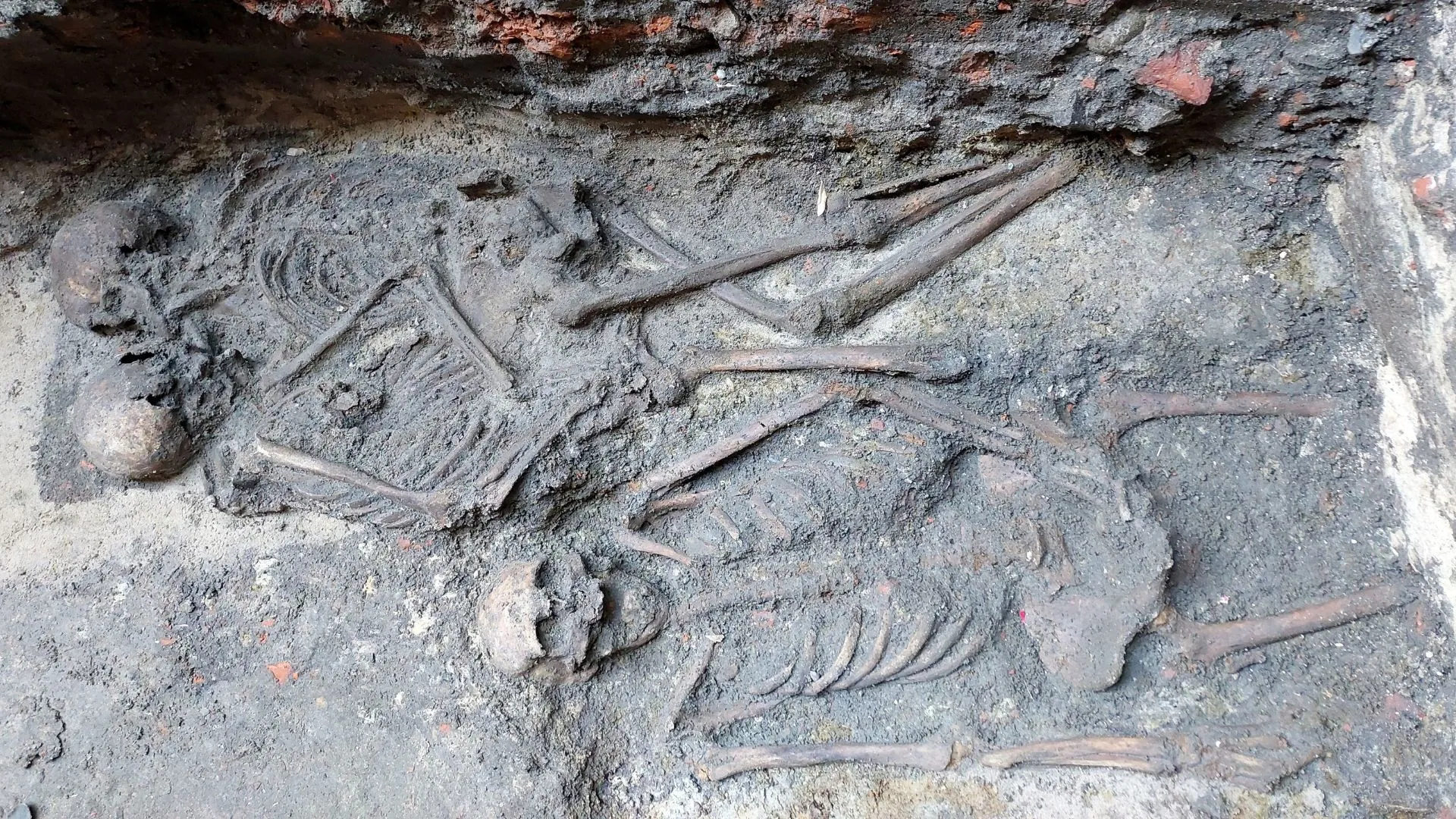
About 800 years ago, two people were buried in an embrace in a prominent church in Poland. Now, a new DNA analysis of the "hugging skeletons" reveals that both individuals were women and that they were not genetically related.
The discovery, which researchers say is the first known same-sex double burial in medieval Poland, raises questions about the women's relationship.
"The discovery of an atypical burial in such a unique setting naturally raised questions about the nature of the relationship between the individuals buried together in a single grave," Agata Cieślik, a biological anthropologist at the Ludwik Hirszfeld Institute of Immunology and Experimental Therapy in Poland, told Live Science in an email.
Mysterious double burial
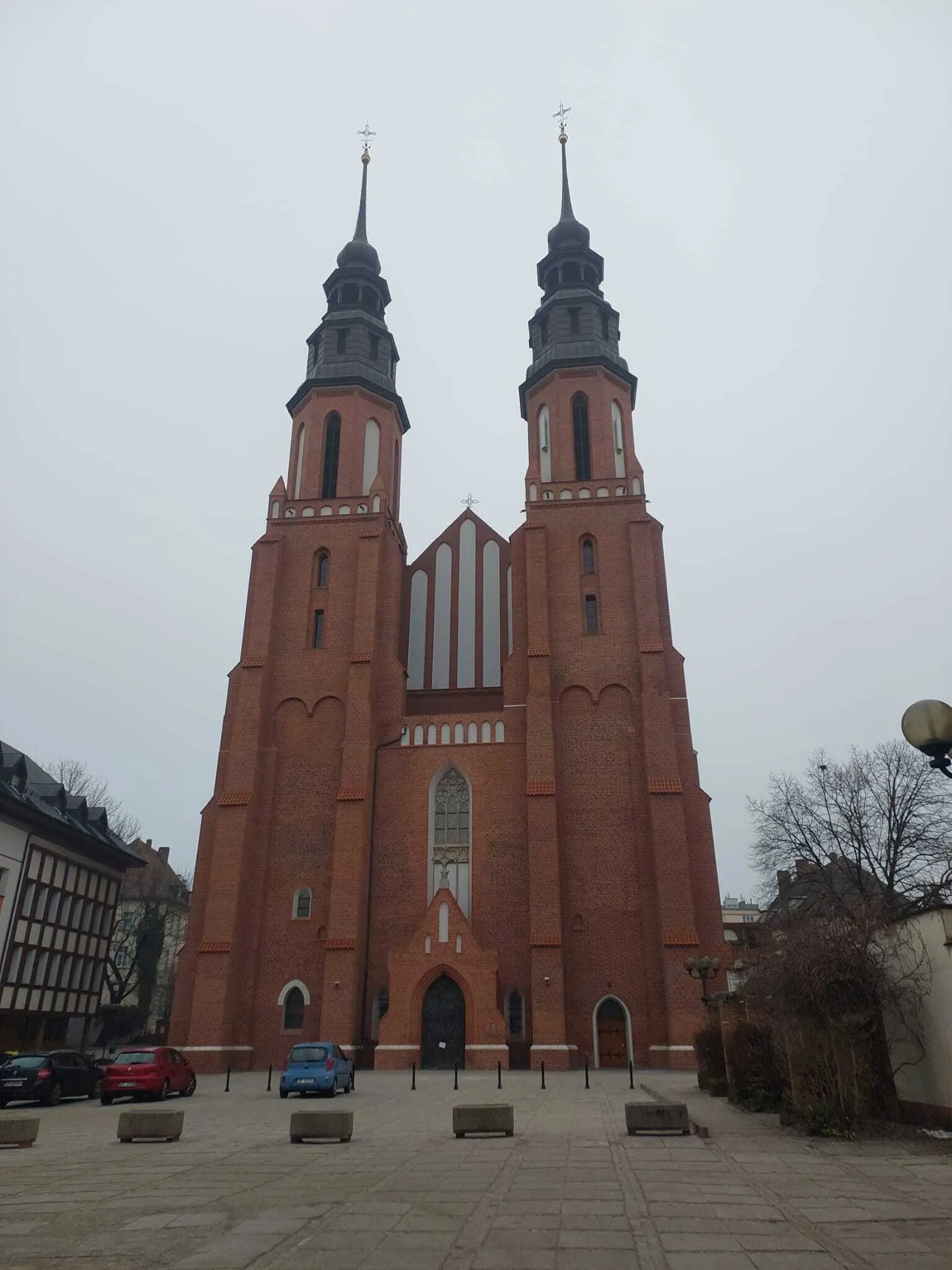
The skeletons were uncovered during archaeological investigations at the 13th-century Cathedral of the Exaltation of the Holy Cross in Opole, Poland, between 2022 and 2025.
One of the individuals had been buried according to Christian rites typical for the time: lying on their back, with their arms placed along their body. The other person had been placed on their side, with one arm beneath the other person's head, as if in an embrace. Based on the burial positions, the researchers think the people were interred simultaneously.
The Cathedral of the Exaltation of the Holy Cross in Opole, Poland.
(Image credit: Magdalena Przysiężna-Pizarska)
Typically, double burials of adults are interpreted as married couples. However, assumptions based on body position and physical sex estimation can be misleading. So in a new study, published in the September issue of in the Journal of Archaeological Science: Reports, Cieślik and her colleagues analyzed the two skeletons' DNA to better understand their relationship.
They extracted DNA from the bones and reconstructed parts of the individuals' genetic code, study co-author Joanna Romeyer-Dherbey, a postdoctoral DNA researcher at Kiel University and Yale University, told Live Science in an email. "We then sequence these fragments and use computational tools to reconstruct parts of the genetic code," Romeyer-Dherbey explained, comparing the process to "trying to reconstruct a book after it has been shredded into countless tiny pieces."
Sign up for the Live Science daily newsletter now
Get the world’s most fascinating discoveries delivered straight to your inbox.
The DNA analysis confirmed that both skeletons were female and that they were not closely related, making the grave the first genetically confirmed same-sex burial in medieval Poland. But the researchers are unsure why two unrelated adult women were buried together.
Some unusual interments in the medieval period were intended to ritualistically prevent the dead from returning or causing harm. These feared individuals — sometimes called "revenants" — were typically buried in isolation and in unholy ground, and were often decapitated or weighed down with stones. But the women's burial next to the cathedral walls — a position often reserved for kings and local notables — and the lack of other evidence of protective rituals suggest that these women were not marginalized by society.
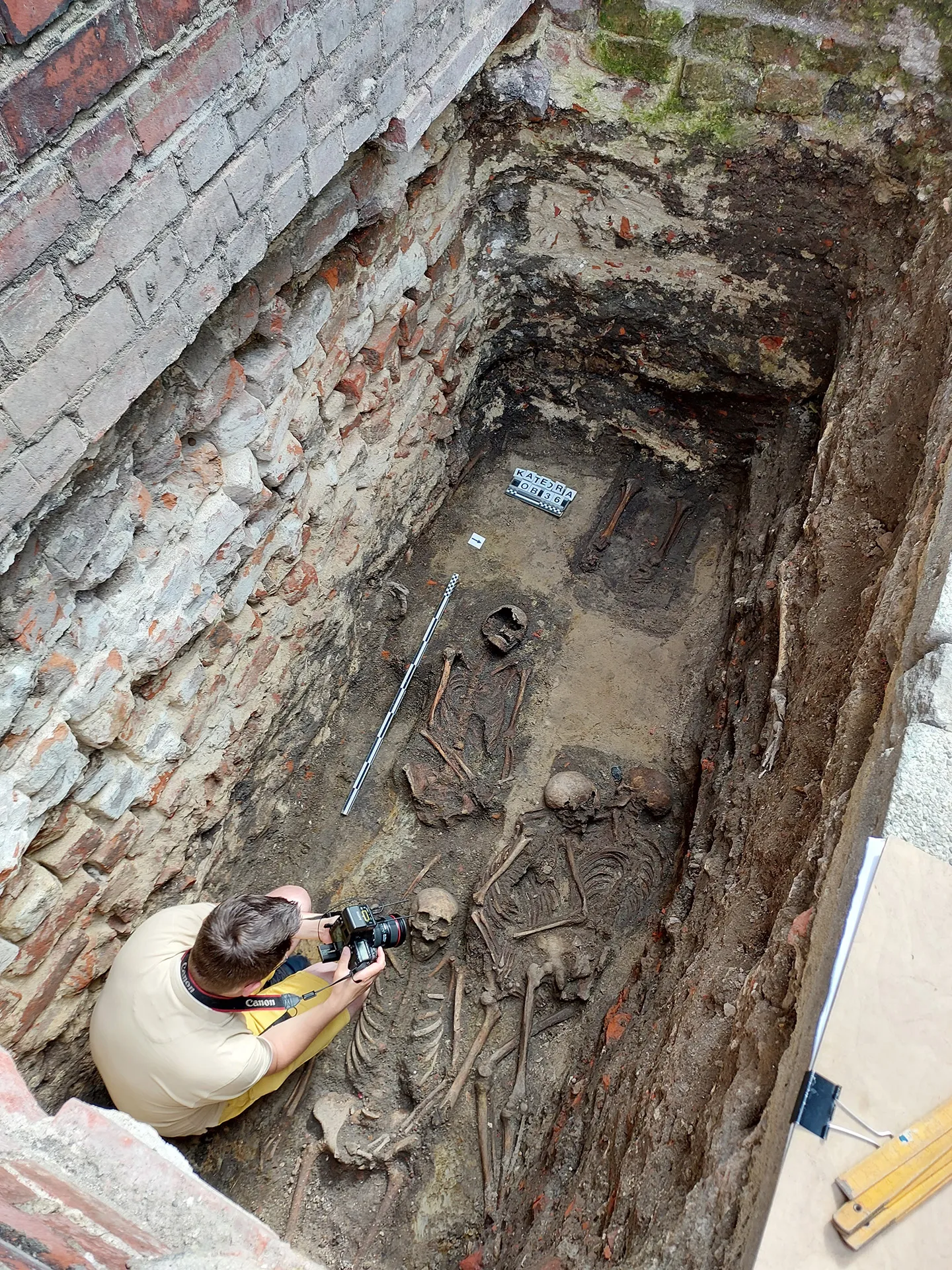
Excavations in Opole, Poland, with multiple burials, including the "hugging skeletons."
(Image credit: Magdalena Przysiężna-Pizarska)
Medieval legal and religious sources harshly condemned same-sex partnerships, often punishing them with execution. If these women had been suspected of being lovers, they would not have been afforded such a prominent grave, the researchers wrote in the study.
The women's exact connection to each other remains a mystery, but past relationships came in diverse forms.
"People might have been connected through religion, shared households, economy, or work, which researchers term 'fictive kinship,'" Cieślik explained. "These socially recognized bonds functioned in ways similar to family ties and might have been reflected in the funerary practices."
According to the study, future genetic analysis of other medieval graves could provide insight into whether such same-sex burials were isolated incidents or part of a larger trend.
In the meantime, the Opole excavations revealed many artifacts, such as coins, jewelry, animal bones and pottery fragments that are still under investigation. "Future analyses will help us better reconstruct the historical landscape and everyday life of medieval Opole," Cieślik said.
Article Sources
Cieślik, A., Da Silva, N. A., Przysiężna-Pizarska, M., Krause-Kyora, B., & Romeyer-Dherbey, J. H. (2026). Ancient DNA analysis sheds light on two individuals buried in a mutual embrace at the Exaltation of the Holy Cross Cathedral in Opole, Poland. Journal of Archaeological Science Reports, 73, 105792. https://doi.org/10.1016/j.jasrep.2026.105792
Sandee Oster is a freelance journalist and Ph.D. candidate based in South Africa. Her beats include archaeology, history and paleontology. Her work has appeared on Phys.org, the Southern African Archaeology Student Society, and she has a popular Medium blog. Her Ph.D. in archaeology is being completed at the University of the Witwatersrand and is focused on developing her zooarchaeological skills, while her master's degree dealt with archaeological rock art.
You must confirm your public display name before commenting
Please logout and then login again, you will then be prompted to enter your display name.

 Live Science Plus