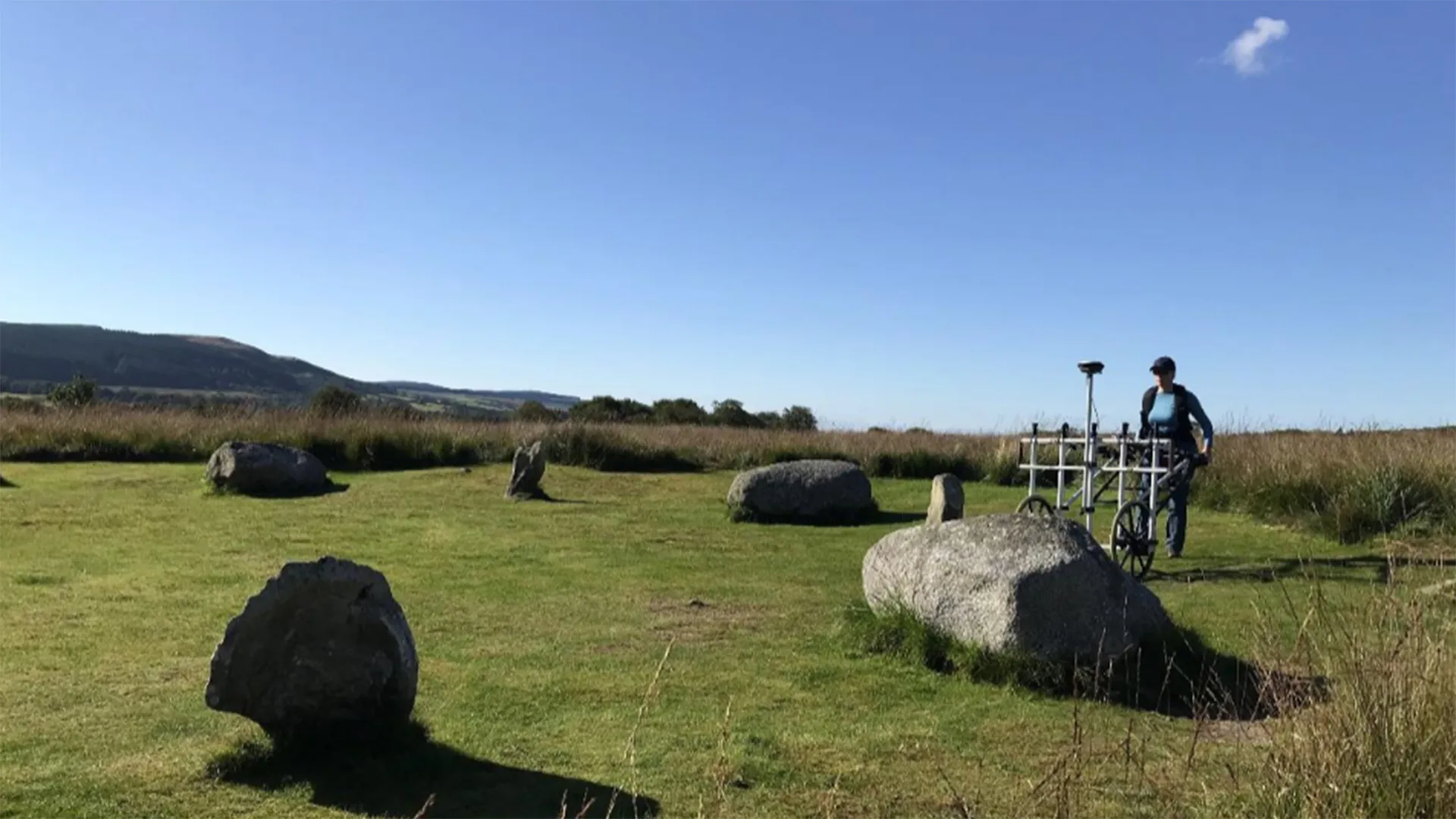
While scanning one of Scotland's richest prehistoric landscapes, archaeologists uncovered evidence of what may be a newfound stone or timber circle buried beneath a peat moorland. The find may add another monument to a ceremonial structure that has fascinated researchers for more than a century.
The possible circle lies beneath the surface of Machrie Moor on Scotland's Isle of Arran, a landscape already famous for its towering standing stones, burial monuments and ceremonial sites dating to between roughly 3500 and 1500 B.C. Researchers from Historic Environment Scotland identified the possible circle using geophysical survey equipment, which is wheeled aboveground and detects subtle magnetic changes underground without disturbing any archaeological remains.
The discovery emerged from a survey designed to test how well modern archaeological instruments work in peat-covered landscapes, but instead the project revealed the unexpected subterranean circle.
"We know that there is a lot of archaeology yet to uncover at Machrie Moor, but the discovery of a new circle completely surpassed our expectations," Nick Hannon, senior heritage recording manager at Historic Environment Scotland, said in a statement released June 30.
While Stonehenge is the world's most famous prehistoric circle, it is only one monument among hundreds built across Britain and mainland Europe during the Neolithic and Bronze ages. Machrie Moor is among the best-preserved examples of these ritual landscapes, with six ceremonial circles already identified since the 1980s.
In fact, the archaeologists found there was more to learn about some of the previously known circles. At Machrie Moor Circle 2, for instance, the team identified a ring of anomalies suggesting the circle may have had 14 stones instead of the seven or eight previously reconstructed.
An excavation of Circle 11 from the 1985 excavation. Circle 11 has been dated to the Bronze Age.
(Image credit: Historic Environment Scotland)
The circles also share a striking orientation: They align with a notch at the head of nearby Machrie Glen where the midsummer sun would have risen, which suggesting astronomical observations may have played a role in ceremonies held there.
Sign up for the Live Science daily newsletter now
Get the world’s most fascinating discoveries delivered straight to your inbox.
Archaeological anomalies
Unlike the circles that had already been discovered at the site, the newly detected monument has not been excavated yet. Instead, researchers identified a ring of magnetic anomalies — subtle disturbances in the soil that often indicate archaeological features such as pits or postholes.
According to the survey report, the feature consists of 12 circular, pit-like anomalies arranged in a circle approximately 92 feet (28 meters) across. The pits are spaced around 21 feet (6.5 m) apart, with two unusually wide gaps that the researchers say could represent the locations of two additional pits that are now decayed. If so, the monument may have originally contained 14 posts or standing stones.
"There is no indication that any of these anomalies contain a stone" at this time, the researchers noted in the report, so the circle could have been built from either timber posts or standing stones that were later removed.
An ancient circle believed to be from the Bronze Age at Machrie Moor in Scotland, looking northward.
Previous excavations have already revealed that several of the other stone circles at Machrie Moor were originally built as timber circles before the wooden posts were replaced with stones around 2000 B.C. Human cremations and bodily burials were later placed within some of the circles, suggesting the monuments' functions changed over time.
"It is likely that the newly-discovered circle dates from a similar period as the other circles still standing," representatives of Historic Environment Scotland said in the statement.
See how much you know about Stonehenge with our Stonehenge quiz!
Kenna Hughes-Castleberry is the Content Manager at Live Science. Formerly, she was the Content Manager at Space.com and before that the Science Communicator at JILA, a physics research institute. Kenna is also a book author, with her upcoming book 'Octopus X' scheduled for release in spring of 2027. Her beats include physics, health, environmental science, technology, AI, animal intelligence, corvids, and cephalopods.
You must confirm your public display name before commenting
Please logout and then login again, you will then be prompted to enter your display name.