













Early Homo sapiens may have lived in rainforests, new clues suggest — and it could overturn our understanding of human evolution
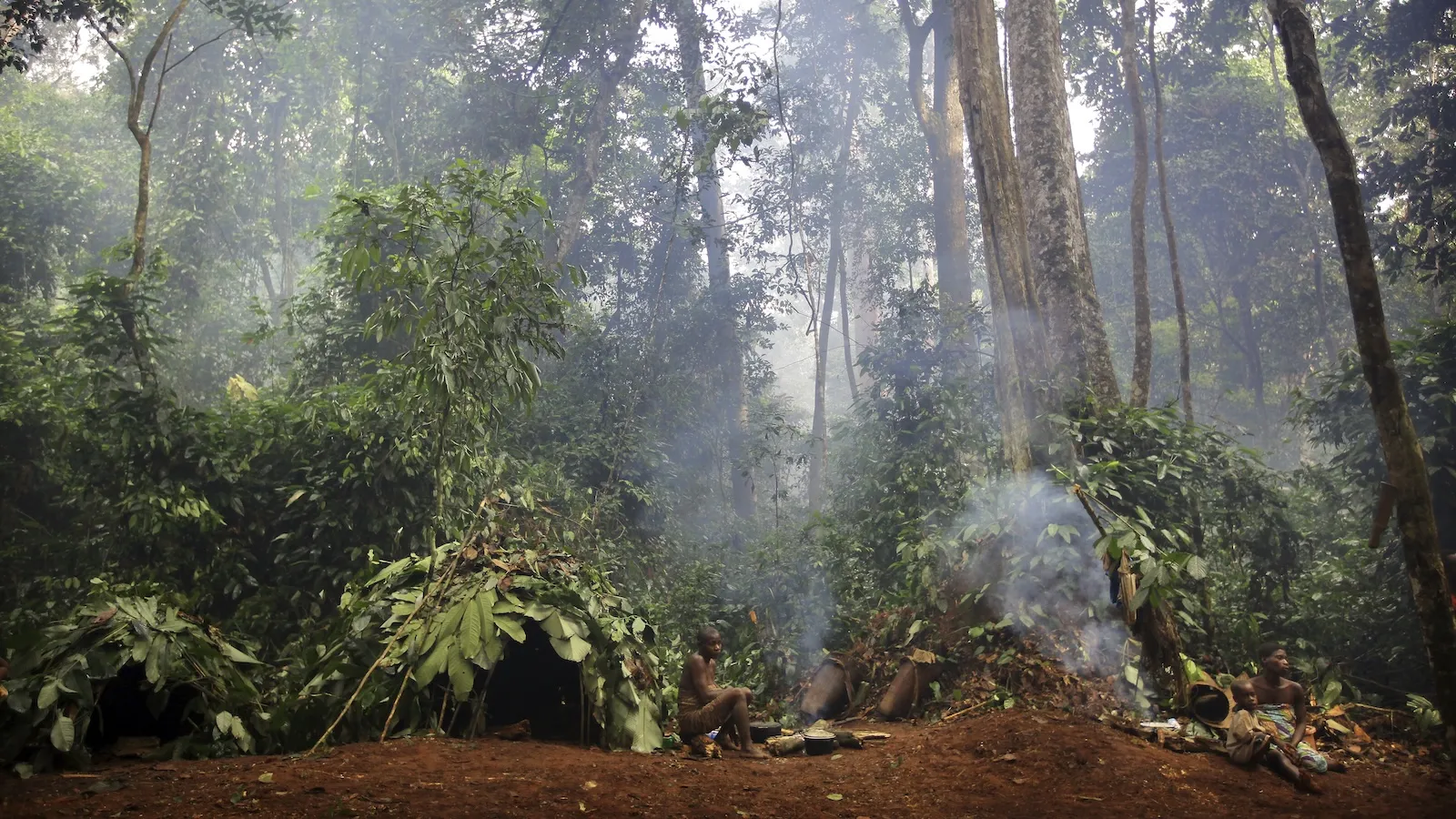
The long-held idea that rainforests held a minor role in our species' evolution is changing — and our ability to adapt to these tropical areas may give insight about "what it means to be uniquely human."

Nearly 70,000 years ago, modern humans created stunning rock art in an unexpected place: the tropical Indonesian island of Sulawesi. The finding, announced in January, made headlines for being the oldest known rock art in the world.
But the discovery's location also highlighted another surprising finding: that members of our species, Homo sapiens, were thriving in the tropics tens of thousands of years ago.
Researchers have long thought that early humans didn't live in tropical rainforests, as these places haven't yielded human fossils and are teeming with dangerous life, including venomous animals, poisonous plants and parasites that would deter early populations.
But that perspective has been changing over the past few decades. Sulawesi's ancient rock art is one of several clues that modern humans may have lived in tropical rainforests for hundreds of thousands of years. That would mean modern humans could have been living in these hot, wet regions since soon after the emergence of our species in Africa around 300,000 years ago.
Understanding how, when and where modern humans inhabited rainforests — and how that shaped our evolution — "may give us an insight into something about what it means to be uniquely human," Patrick Roberts, an archaeologist and anthropologist at the Max Planck Institute of Geoanthropology and author of the book "Jungle: How Tropical Forests Shaped World History" (Penguin, 2022), told Live Science.
From one origin story to many
Conventional wisdom held that modern humans emerged from one parent population in an East African savanna and did not encounter rainforests until around 12,000 years ago, after agriculture emerged to support survival in these climes. The lack of H. sapiens fossils from Africa's tropics appeared to support this view.
Then, in 2017, scientists identified the oldest modern-human fossils — except they weren't in East Africa, but rather in Jebel Irhoud, Morocco. The following year, Eleanor Scerri, an archaeological scientist at the Max Planck Institute of Geoanthropology in Germany, and her colleagues reviewed archaeological evidence, including the Jebel Irhoud fossils, and integrated it with genetic data from present-day populations. The evidence pointed toward H. sapiens originating from many subdivided populations across Africa.
Get the world’s most fascinating discoveries delivered straight to your inbox.
These populations periodically met and exchanged genes and ideas, but they also spent long periods apart, adapting to different ecosystems and evolving diverse traits. In this new understanding, the earliest members of our species may have evolved not just in the grassy savanna but in tropical rainforests, too.
"One of the implications of the model is, if it's not one place and it's many places, then maybe it's not one ecosystem," Scerri told Live Science. "Maybe it's many ecosystems."

Tropical rainforests were long considered too challenging for early members of our species to have lived in.
Because rainforests come with their own set of environmental pressures, people who lived there may have evolved traits to handle those challenges. When different early human populations came together, tropical rainforest dwellers would have contributed different gene variants than populations from open savannas. The ability to adapt to a variety of environments, including rainforests, may have come in handy later, when H. sapiens spread out of Africa and into tropical Southeast Asia, including places like Sulawesi.
But establishing what these traits were would first require evidence that humans lived in rainforests close to the dawn of our species.
Rainforests are terrible for fossil hunters
Unfortunately, the highly acidic soil in rainforests degrades organic material like bones. This makes evidence of ancient humans, such as fossils, or human activities, like bone arrows or potential woven fiber baskets, exceptionally rare in rainforests.
Even in the few instances this evidence is found, the conditions make it hard to date and contextualize it. Archaeologists often date early human fossils by measuring radioactive isotopes (versions of elements), such as carbon-14, in distinct, undisturbed layers of sediments — broken-down rocks and minerals that form via erosion and weathering. The more sediment layers there are, the longer the period of history that can be traced. But weather conditions in West and Central Africa's rainforests have left few long sediment sequences.
The lack of long sediment sequences also significantly reduces the odds of finding fossils at all, said Antonio Rosas, a paleobiologist at the National Museum of Natural Sciences in Spain who has been searching unsuccessfully for such fossils in Equatorial Guinean rainforests since 2014. "To be honest, I think I gave up the possibility of finding fossils properly," Rosas said.
Written in stone
As a result, many researchers studying early H. sapiens evolution have focused on a material that does preserve: stone.
In Africa, stone tools reveal humans were in coastal tropical forests in what is now Kenya roughly 78,000 years ago, the tropical rainforests of what is now Equatorial Guinea from around 45,000 years ago, and the rainforests of what is now the Democratic Republic of the Congo around 18,000 years ago.
Then, in 2025, researchers revealed that stone tools previously found in a tropical rainforest in the Ivory Coast in the 1980s were 150,000 years old. Because the area was also a tropical rainforest 150,000 years ago, this is evidence that our species inhabited rainforests "much earlier than previously thought," study first author Eslem Ben Arous, a geochronologist and archaeologist at the National Research Center on Human Evolution in Spain, told Live Science in an email.

Stone tools like this one, excavated in the Ivory Coast, reveal that humans were present at the rainforest site roughly 150,000 years ago.
The antiquity of these quartz tools — which were a mix of flakes and heavy-duty picks and choppers — show that early H. sapiens were capable of designing technology to survive in dense tropical forests. Dense forests weren't a barrier for early humans at that time, Ben Arous said.
Direct evidence
Although stone tools show ancient people were venturing into forests for food or living there part time, they don't prove humans lived there year-round. To do that, researchers still need fossils.
By analyzing the isotopes of elements found in human tooth enamel, researchers can reveal whether our distant relatives actually lived in rainforests. That's because closed, dense canopy rainforests have low levels of sunlight and high carbon dioxide, and the ratio of isotopes of elements in a person's teeth can reveal if they spent a lot of time in those conditions as a child.
Currently, zinc isotopes in two 46,000- to 63,000-year-old human teeth found in Tam Pà Ling cave in Laos are the oldest evidence of humans eating foods mainly from a tropical rainforest.
Similar evidence is currently lacking from African rainforests. But the ability to adapt to many different environments, including rainforests, and the capacity to develop highly specialized traits for such environments is "what's unique about our species," Roberts said.
Identifying adaptations
Early members of our species would have required certain adaptations to live in rainforests. So what were they?
Without preserved DNA or fossils, anthropologists guess by looking at contemporary populations living in the tropics. Many modern-day rainforest inhabitants are small, because it may help them cool off more easily, reduce their caloric needs, and make it easier to move in dense rainforests.
An analysis published in 2019 also found key differences in genes related to immunity and development in African rainforest hunter-gatherers compared with neighboring farmers. For example, the gene PITX1 — which codes for proteins crucial for limb development — is one of several genes that contributes to small stature and shows strong signs of positive selection in Gabonese hunger-gatherer populations.
There is evidence in multiple rainforest dwelling populations, including in those Gabon hunter-gatherers, of selection against specific pathogens.
Although early H. sapiens living in rainforests likely faced similar pressures, we don't have any evidence that similar adaptations evolved in these ancient members of our species.
Ancient DNA may be the key
But some scientists hope to someday find evidence of these adaptations in ancient DNA.
DNA preservation was historically considered impossible in hot and humid environments, but that assumption "turns out to be only partially true," Miklós Bálint, a functional environmental genomicist at the Senckenberg Biodiversity and Climate Research Centre in Germany, said in a statement.

Researchers can find ancient DNA lurking in the environment by analyzing sediment cores from tropical lakes.
Bálint and his colleagues recently reviewed ancient environmental DNA (aeDNA) recovered from tropical environments. They found 113 studies reported aeDNA in tropical and subtropical habitats between 1998 and 2025, including 1 million-year-old aeDNA extracted from a lake in Indonesia. This DNA came mainly from nearby plants, not from ancient humans. But because people leave "millions of DNA traces" in their environment during their lifetime, human DNA should also be present and retrievable, Bálint said in the statement.
"Obtaining DNA data will be a truly fundamental breakthrough in tropical forest research," Ben Arous said. For example, these genetic remnants peppered throughout the environment could reveal how humans changed the ecosystem, how they moved and interbred, and which diseases and parasites ancient people faced.
RELATED STORIES
The new discoveries point to the need for more archaeological research in rainforest environments, Scerri said. Current efforts in Benin appear "really, really promising," Scerri said, and she and her team are also working on projects in Guinea, Ghana and Senegal, which are also yielding clues to ancient human habitation. "We're making some incredible finds," she said.
"There is enough evidence now to justify investigating areas that used to be well off the human origins map, considered to be very far from the main stage of human evolution," Scerri said.
The question now is how much further back in time people were living in rainforests and using their resources. "We consider ourselves to really be scratching the surface," Scerri said.
Human evolution quiz: What do you know about Homo sapiens?

Sophie is a U.K.-based staff writer at Live Science. She covers a wide range of topics, having previously reported on research spanning from bonobo communication to the first water in the universe. Her work has also appeared in outlets including New Scientist, The Observer and BBC Wildlife, and she was shortlisted for the Association of British Science Writers' 2025 "Newcomer of the Year" award for her freelance work at New Scientist. Before becoming a science journalist, she completed a doctorate in evolutionary anthropology from the University of Oxford, where she spent four years looking at why some chimps are better at using tools than others.
You must confirm your public display name before commenting
Please logout and then login again, you will then be prompted to enter your display name.